
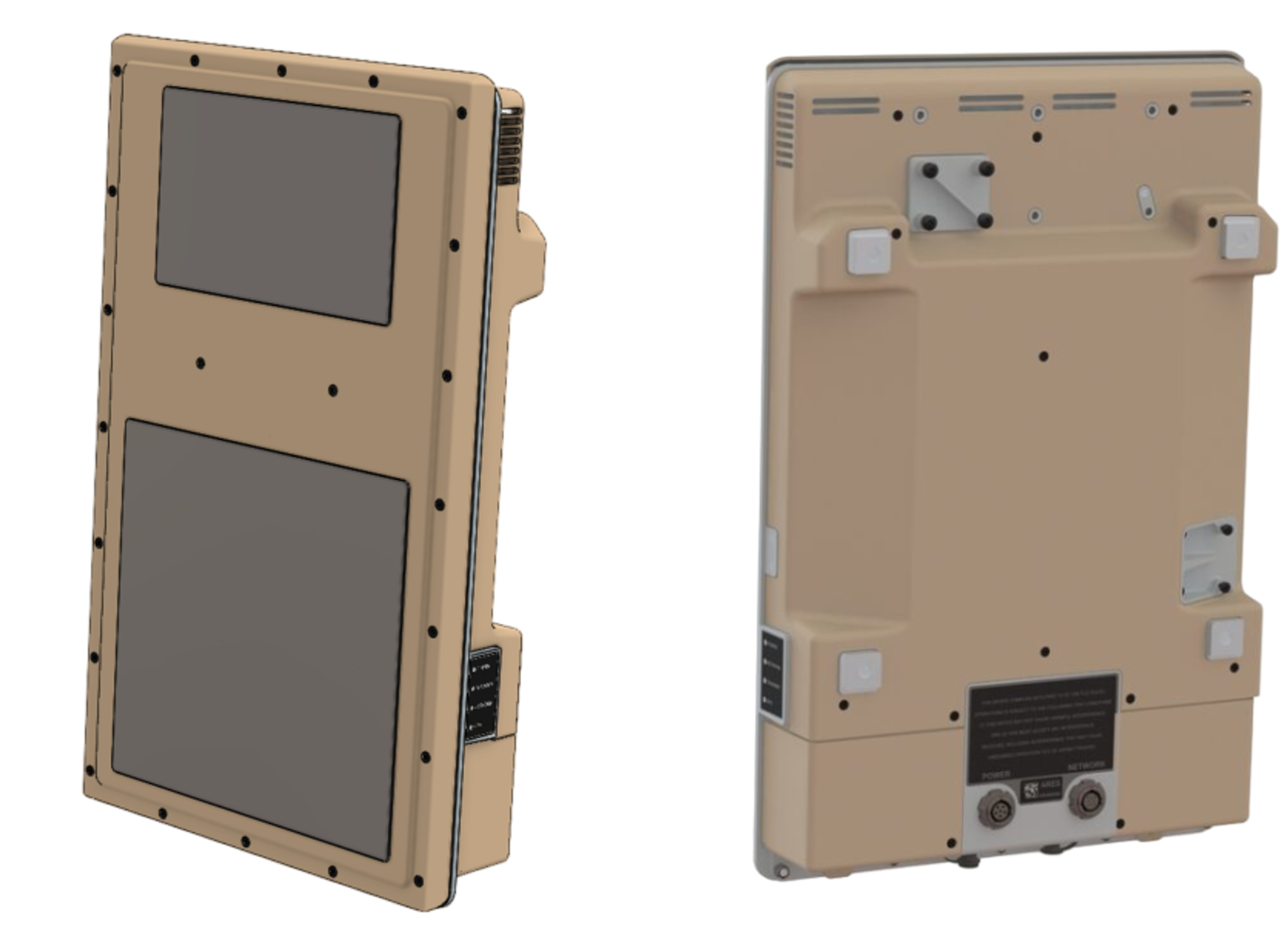
Long-Range Airspace Awareness, Without the Long-Range Compromise
Not best in class — in a class of its own. The Fortem TrueView® R40 sets a new standard of performance in tracking at long range with minimal size, weight, and power requirements at low cost.
For as long as radar has existed, range has come at a price. Seeing farther meant building bigger — heavier arrays, hungrier power supplies, fixed installations bolted to the ground.
The TrueView® R40 was built to break that bargain. It delivers Fortem’s longest detection range yet — tracking aircraft out to 13 kilometers and small drones to 4 — in a package light enough to carry and efficient enough to run from a vehicle.
Fixed site or on the move, the R40 detects and tracks drones, aircraft, vehicles, and personnel without asking you to trade away size, weight, power, or cost to get it.
Why the R40
Long-range by design. Detect and track small drones at 4 km, larger platforms and aircraft well beyond, with an instrumented range reaching 32 km. The R40 sees threats forming while there’s still time to act.
Sees the hard targets. Full 3D tracking of the low, slow, and small drones that slip past conventional radar — in real time, and with the accuracy operators can act on.
Carries its own weight. At as little as 17 lbs, the R40 goes where long-range radar usually can’t: onto vehicles, vessels, towers, aircraft, and remote sites.
Air and ground. Beyond drones and aircraft, the R40 classifies vehicles and personnel on the ground — extending a single sensor across the full picture.
Layered EO/IR integration. Pair the R40 with electro-optical/infrared cameras for visual confirmation on every track.
Built to endure. Rated from -40° to +65°C and hardened for demanding, real-world deployments.
The Trade-Off Nobody Wants to Make
Every airspace defender eventually runs into the same wall. The radars that see far enough are too big to move and too power-hungry to deploy widely. The radars that are small and mobile don’t see far enough to matter.
So, you compromise — on coverage, on placement, on how much of your perimeter you can actually watch.
The R40 was engineered to erase that compromise. Fortem’s discipline around SWaP-C — size, weight, power, and cost — has always meant refusing to accept that better performance requires a bigger, heavier, costlier box.
With the R40, that discipline is pointed at the hardest problem in the lineup: long range. The result is a radar that sees like a fixed-site system and deploys like a mobile one.
Detect Farther
Range isn’t a number on a datasheet. It’s reaction time. The farther out you see a threat, the more room you have to identify it and respond before it reaches whatever you’re protecting.
The R40 is Fortem’s longest-reaching radar:
- Small UAS: 4 km
- Fixed-wing UAS: 5.2 km
- Large multi-rotor: 5.5 km
- Aircraft: 13 km
-
Instrumented range: up to 32 km
A single R40 covers up to 150° × 150°, and radars combine to deliver seamless 360° awareness across a site or a moving platform — no gaps, no blind arcs, no seams to exploit.
Low SWaP-C, High Reach
Long-range radar has a reputation: massive, fixed, and thirsty for power. The R40 rewrites it.
At 17 to 20.4 lbs, and drawing roughly 220 watts — modest enough to run off a vehicle or vessel’s own power — it installs where you need coverage, not just where the infrastructure happens to allow it.
Towers, trucks, boats, aircraft, remote outposts: the R40 maximizes what a single sensor can do while minimizing what it costs to put there.
A Different Kind of Signal
The R40 pairs a true AESA (active electronically scanned array) with an FMCW waveform, and the combination does more than extend range.
Because FMCW spreads the radar’s energy across frequency, time, and space, the R40 leaves no blind zone in its field of view — and its emissions are far harder for an adversary to detect and locate. You see them; they don’t see you looking.
Underneath, digital beamforming, space-time adaptive processing (STAP), and adaptive clutter filtering let the R40 hold clean tracks in exactly the environments that defeat lesser radars: dense urban clutter, ground return, harsh weather.
AI at the Edge
Detection alone was never the point. A radar that cries wolf — flagging every bird as a drone — is as dangerous as one that stays silent.
The R40 does its heaviest thinking on the sensor itself, with a 5.5-teraflop GPU and FPGA driving AI classification that separates real threats from the noise.
Fortem can rightfully claim that TrueView was the first radar to integrate a GPU inside the sensor. We achieved this a decade ago, enabling advanced machine learning to run directly on the radar at the computational edge and allowing it to track and classify targets without any external compute or processing requirements.
Objects are assessed by their micro-Doppler signature, pattern of movement, size, position, and velocity — many at once — so operators respond to threats, not false alarms.
Technical Specifications
| Specification | Value |
|---|---|
| Tracking Range (Small UAS) | 4 km |
| Tracking Range (Large UAS) | 5.5 km |
| Aircraft Tracking | 13 km |
| Instrumented Range | Up to 32 km |
| Field of View | Up to 150° × 150° |
| Weight | 17–20.4 lbs |
| Power Draw | 220 W |
| Operating Temperature | -40° to +65°C |
| Processing | AESA architecture · FMCW · digital beamforming · STAP · adaptive clutter filtering · 5.5 TFLOP GPU + FPGA |
Request More Information
Use this form to open dialogue with us. You’ll be contacted by a real specialist, operating in the United States, who can discuss your specific needs at length. Please allow 5-7 business days for the right person toget in touch with you.