

Corporate America needs to wake up to the threat of drone espionage
In October 2023, a worker at a hazardous waste facility in Gum Springs, Arkansas, owned by French multinational Veolia spotted a drone hovering over restricted areas of the plant. When he traced the drone to its pilot, he discovered the operator wasn’t a mere hobbyist: he was an employee of Veolia’s direct competitor, Clean Harbors, which operates its own hazardous waste facility about an hour’s drive from Gum Springs. Under questioning, the pilot admitted he had been instructed by his boss to perform aerial surveillance of the site.
The timing was no accident, Veolia said in a lawsuit it filed against Clean Harbors later that month. The Gum Springs facility was undergoing a $300 million expansion, and the drone had been gathering intelligence – “information and pictures of the critical infrastructure built by the plaintiff,” as Veolia put it.
Drones add a new and dangerous dimension to the theft of intellectual property, which has been estimated to cost the U.S. economy up to $600 billion annually. Inexpensive, stealthy, and increasingly autonomous, drones can collect surveillance from angles that make walls, fences, and guarded gates irrelevant. In its Worldwide Threat Assessment released earlier this year, security firm Global Guardian warned that organizations are “highly vulnerable to drone-assisted espionage” and that countermeasures are lagging far behind the threat.
The New Espionage Playbook
The drone-espionage threat spans every sector where intellectual property drives value. In 2019, during Denmark’s €200 million 5G network upgrade, China’s Huawei deployed drones to surveil competitor Ericsson’s bid negotiations with telecom giant TDC. According to investigators, drones hovered outside 15th-floor meeting rooms, photographing whiteboards containing sensitive contract details, while the company simultaneously tapped boardroom microphones – a multipronged espionage effort that ultimately cost Huawei the contract.
Military installations have proven equally vulnerable. In July 2024, a Chinese national and University of Minnesota graduate student pleaded guilty in federal court to charges that he used a drone to photograph classified U.S. Navy ships being built at the Newport News Shipyard in Virginia.
And drones aren’t limited to capturing video and photos. In an alarming case from 2022, a financial-services firm discovered that intruders had used drones to penetrate its Wi-Fi network. Attackers first flew a drone near a remote employee’s home to steal login credentials, then landed two modified drones on the company’s roof. Equipped with a Wi-Fi penetration device and a mini-computer, they attempted to connect to internal servers and exfiltrate sensitive data.
Fortunately, the attempt was discovered in time. But the lesson is clear: drones have become cyber-physical attack platforms, extending espionage into the digital core of business operations.
Most companies remain unprepared. Radio-frequency jammers are restricted by law. Optical sensors fail at night or in bad weather. Fiber-optic guided drones emit no radio signals, bypassing conventional detection. Even when a drone is identified, companies generally lack the legal authority to disable it. In practice, adversaries can fly – and spy – with little fear of consequence.
Yet the math for investing in proper drone defense is compelling. Consider that a single trade secret – a manufacturing process, a client list, a product roadmap – can represent years of R&D investment worth millions or billions, while modern drone detection and interdiction systems cost a fraction of that amount. In this context, drone defense is not so much a cost as it is insurance against catastrophic competitive disadvantage.
Fighting Fire with Fire
While the challenge is serious, proven defensive technologies exist that can protect corporate assets without violating regulations. Fortem Technologies today is the only company authorized to deploy a drone-on-drone kinetic interceptor in U.S. airspace. Our AI-powered SkyDome® Family of Systems combines TrueView™ radar, command-and-control software, and autonomous DroneHunter® interceptors to detect, pursue, and take out unauthorized drones.
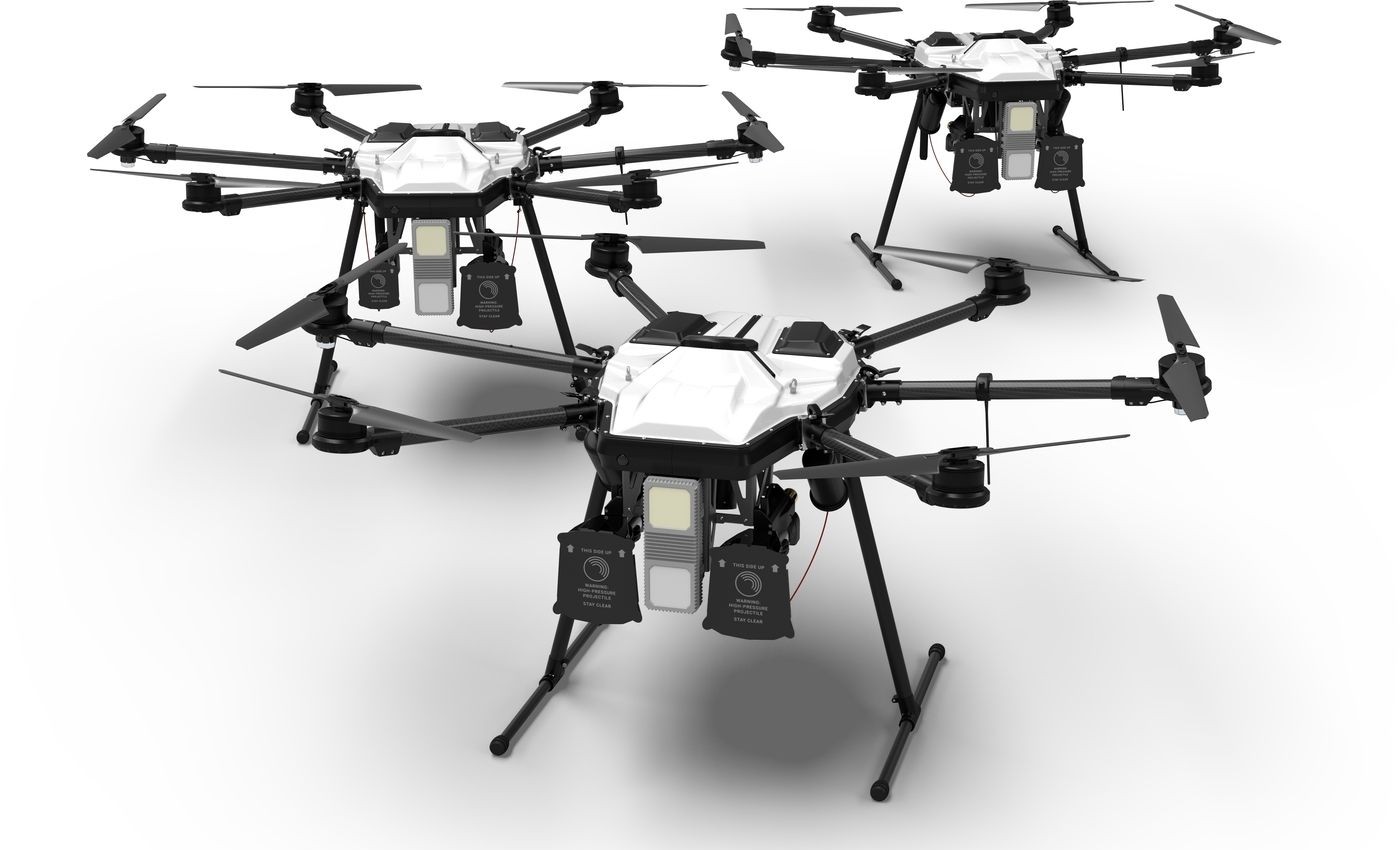
Because DroneHunter can retrieve drones intact, it also preserves evidence, allowing companies and law enforcement to trace espionage campaigns back to their source. Fortem’s solutions are already protecting military, government, and commercial operations worldwide from hostile or unauthorized drones, with technology that’s been validated in operational deployments in Ukraine, the Middle East, East Asia, and along the U.S. southern border.
The technology works because it matches the threat. When a suspicious drone enters protected airspace, TrueView radar – which achieves 95% accuracy in distinguishing drones from birds, debris, or weather events – immediately classifies and tracks it. If the drone poses a threat, DroneHunter launches autonomously, pursuing and capturing the intruder with a net before safely returning it to the ground. Response times below 200 milliseconds mean threats are neutralized before damage is done.
What Companies Must Do Now
Boards and executive teams can no longer treat drone defense as a military problem. Every enterprise with valuable intellectual property – from aerospace to pharmaceuticals to semiconductors – must act.
Start with a risk assessment: What’s visible from above? Manufacturing processes, prototype testing, facility layouts – if a drone can see it, someone will try to steal it. Work with your legal team to understand the regulatory environment and establish protocols for documenting incidents. Train your staff to recognize and report suspicious aerial activity; most drone incidents are first spotted by human observers.
Most critically, deploy detection and interdiction systems before you become a victim. The investment required – typically less than the cost of a single senior hire – pales in comparison to the potential losses. A single stolen trade secret can destroy years of competitive advantage. A compromised network can cost millions to remediate. A leaked product roadmap can hand your market to competitors.
With 2026 CapEx planning cycles under way at many companies, now is the time to prioritize investing in protective infrastructure that matches the evolving threat. The spy in the sky is already here, and organizations with valuable IP or competitive intelligence should assume they’ll be targeted by drone-based espionage. What you do now will define your defense tomorrow.


Related posts